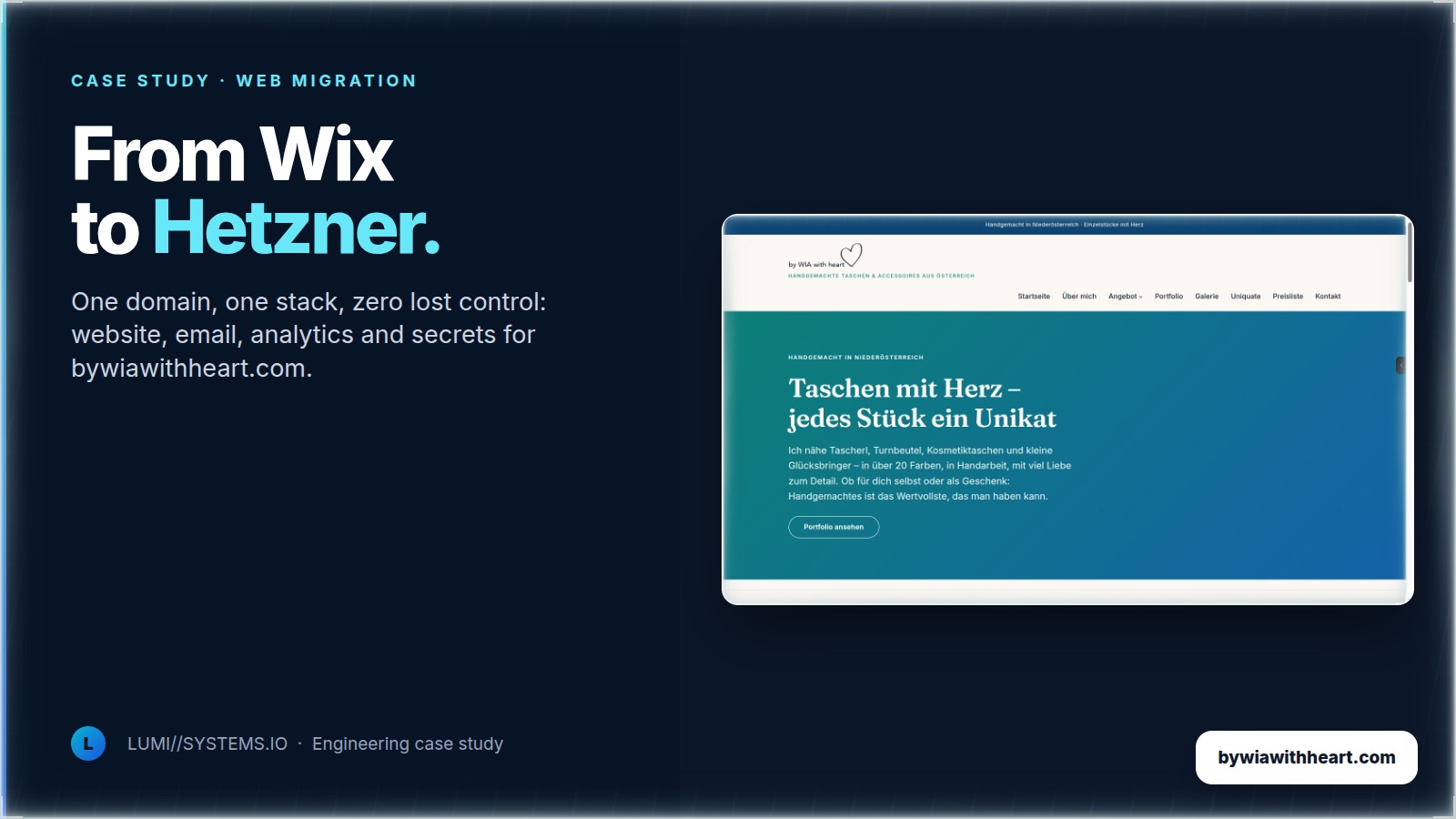
From Wix to Hetzner: A Complete Website Migration Case Study
bywiawithheart.com is a small Austrian brand with a clear promise: handmade bags and accessories, one piece at a time. The website had grown with the business, but it lived inside a closed website builder. That worked while the brand was small. It became a liability when the site needed to become a real business asset: own the domain, own the content, own the mailboxes, own the measurement, and know exactly who can change what.
This is the story of moving the brand from Wix to a self-managed Hetzner stack — not as a lift-and-shift, but as a controlled migration across six layers: domain, DNS, website, email, analytics and secrets.
In this article · 8 min read
Key takeaways
- A website migration is not a file copy. It is a coordinated change to domain, DNS, TLS, mail, content, analytics and access.
- Own the layers that create lock-in: the domain, the DNS zone, the content database, the email domain and the measurement.
- Stage in a separate environment; validate the production hostname, certificates, redirects and mail authentication before the public cutover.
- Self-hosted, cookieless analytics can answer the business question without a consent banner or a third-party tracker.
- Credentials belong in a secret manager, not in the repository, a spreadsheet or a chat. Infrastructure is not finished until it is observable and recoverable.
The brief
The starting point was a working Wix site with a clear identity and a practical problem: the brand wanted a website it could evolve on its own terms, with professional email on its own domain and a measurement layer that respects visitors. “Move it to Hetzner” was the short version. The long version had five requirements:
Own the domain and the content
The domain, DNS zone, WordPress database and media library must be under the client’s control — not a side effect of a builder subscription.
Keep the brand recognizable
The new site had to feel like bywiawithheart: warm, handmade, personal — while improving speed, mobile navigation and editorial clarity.
Mailboxes on the same domain
Role addresses for enquiries, orders and operations, with IMAP/SMTP access and correct SPF, DKIM and DMARC.
Know what happens — without surveillance
Page views and acquisition channels are useful. A third-party advertising profile is not. The analytics choice had to fit Austrian privacy expectations.
Those requirements shaped the architecture before a single page was rebuilt.
The target architecture
We did not replace one monolith with another. The new platform separates concerns so each layer can be changed, observed and recovered independently:
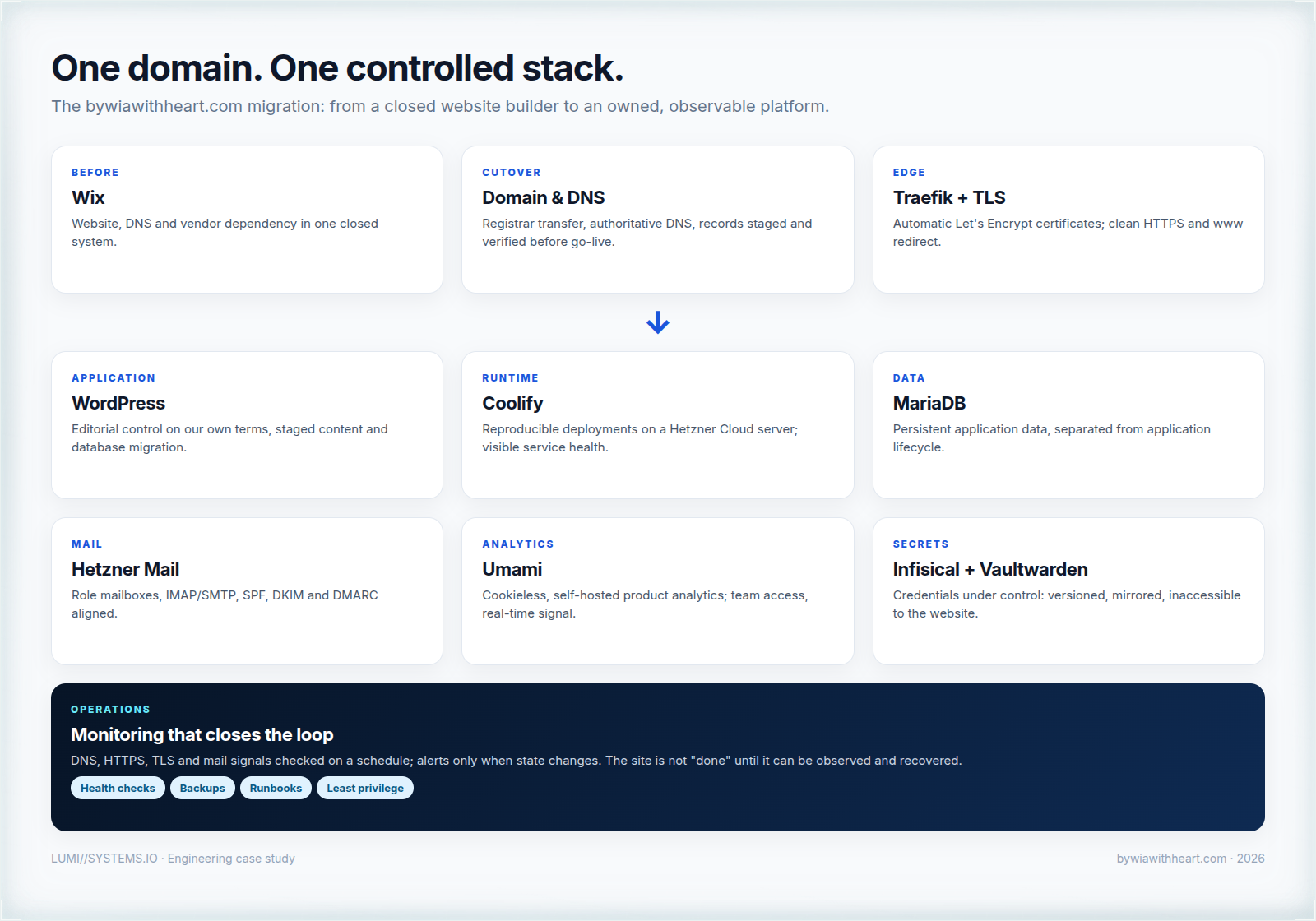
Hetzner Cloud
A dedicated virtual server with predictable resources and full root access. No shared-hosting surprises.
Coolify
Services are deployed as reproducible containers; health, logs and domains are visible in one place.
WordPress + MariaDB
Editorial control stays with the client. The database and media library are portable and backed up.
Traefik + Let’s Encrypt
Automatic certificates, clean HTTPS and a single canonical hostname with a www redirect.
Hetzner Mail
Role mailboxes with IMAP/SMTP, plus SPF, DKIM and DMARC aligned to the sending domain.
Umami
Self-hosted, cookieless product analytics with a small team dashboard — no advertising profile.
Domain, DNS and email
The domain was the first dependency to remove. We transferred the registration to Hetzner and moved the authoritative DNS zone into the same account as the server and the mail system. That does not make the setup less redundant — it makes the responsibility explicit: one owner, one place to audit records.
Before changing the public records we prepared the complete target zone: an A record for the apex and www, the MX record for the Hetzner mail server, SPF, DKIM and DMARC. The sequence mattered. TLS, mail and the website each depend on a different record being correct; changing them one by one without a checklist is how migrations produce “it works on my laptop” incidents.
SPF, DKIM, DMARC
SPF authorizes the sending infrastructure. DKIM signs outgoing messages with a selector-specific key. DMARC tells receiving servers what to do when authentication fails and where to send aggregate reports.
Four role addresses
Personal, office, IT and webmaster mailboxes share the domain but not the purpose. Each has its own credentials, stored in the team vault — not in the website database.
We verified the mail path in both directions: SMTP submission and IMAP retrieval, internal delivery, DNS records and message authentication. A mailbox that can receive but cannot send (or lands in spam) is not a finished mailbox.
Rebuilding the website
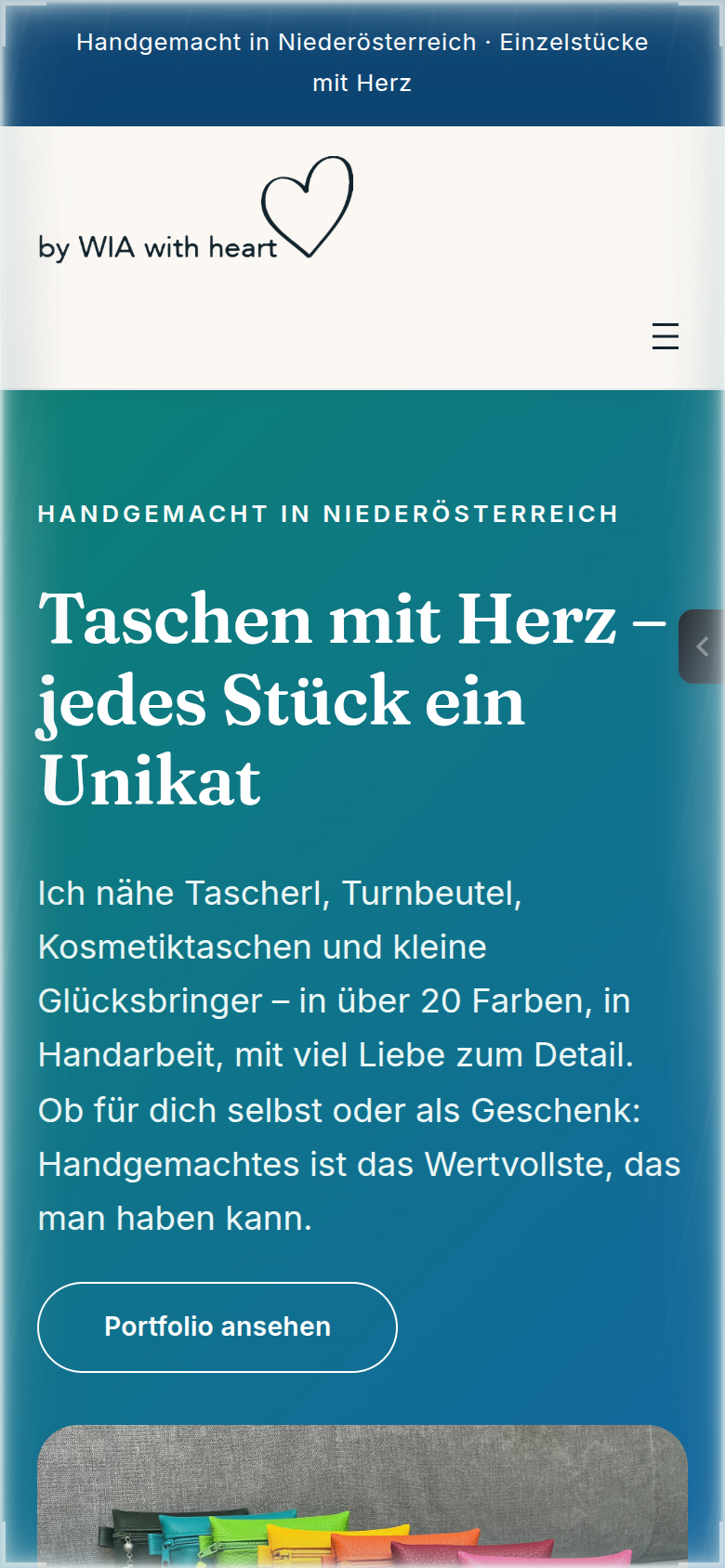
The new website is a WordPress installation, but the design is deliberately not a generic theme demo. The visual system keeps the brand’s warmth: generous whitespace, a calm palette, large product imagery and a clear path from “what is this?” to “show me the portfolio” to “contact”.
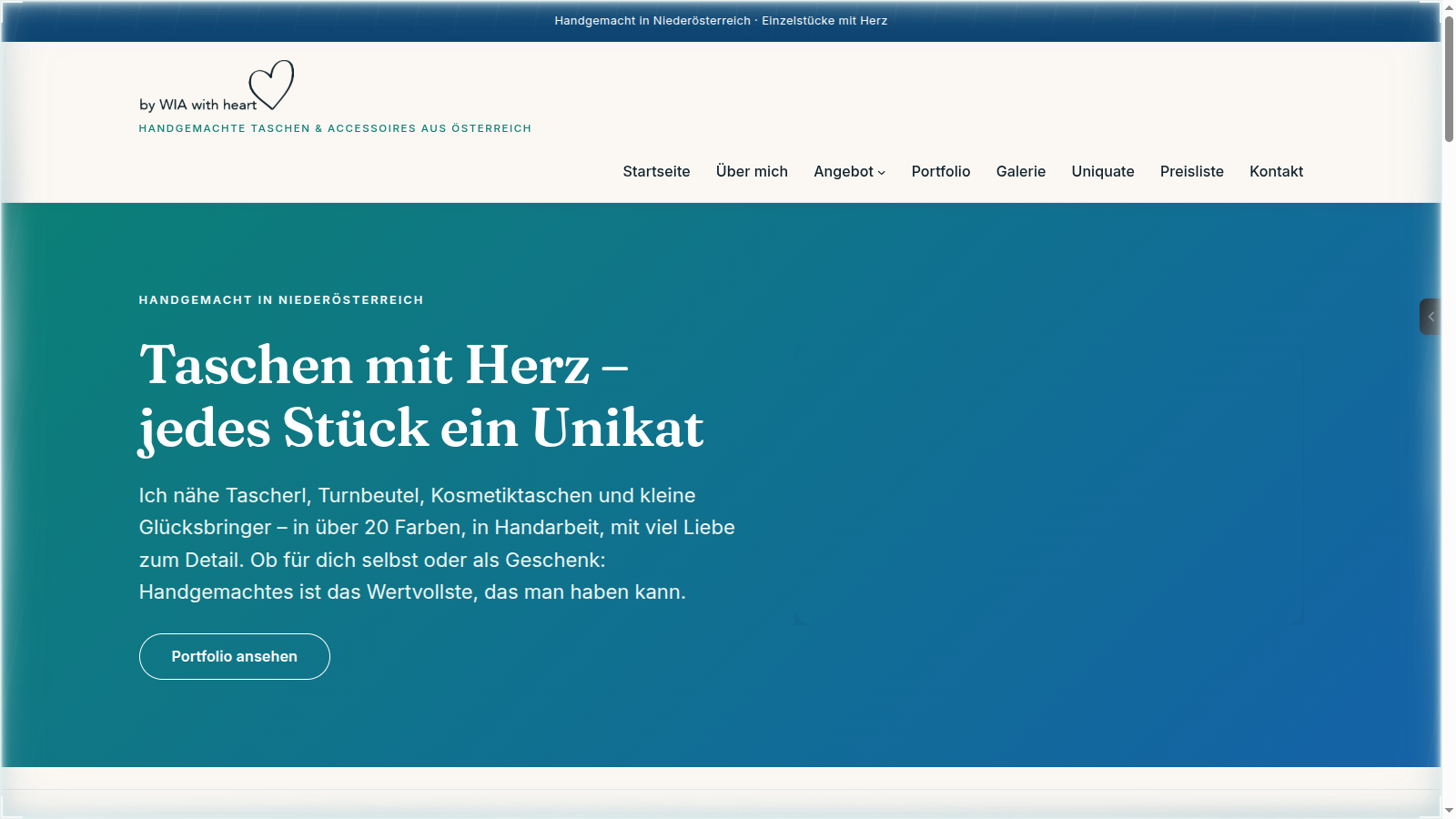
Pages that answer a question
Home, about, offer, portfolio, gallery, price list and contact each have one job. The navigation reflects how a customer decides, not how the old site was organised.
Built for the phone first
Most visitors arrive from Instagram or a shared link. The mobile layout was checked at 390 px, with readable type, tappable targets and no horizontal squeeze.
Content and media were migrated into the new installation, the WordPress address was set to the production domain, and internal links were checked after the search-and-replace. The staging hostname remained available during validation and was retired from the public path after acceptance.
Analytics without surveillance
We replaced the old tracking with a self-hosted Umami instance on the same server. Umami records page views, referrers, devices and countries without cookies or cross-site profiles. For a small brand with Austrian and EU visitors, that is a much better fit than an advertising-driven analytics product.
No consent banner by design
Cookieless measurement reduces the consent surface. The remaining configuration still matters: data minimisation, clear ownership and a defined retention policy.
A dashboard, not a data silo
Both the client and Lumi get named accounts in a shared team. The canonical website ID is documented; duplicate dashboards are exactly the kind of detail that makes a team distrust the numbers.
Secrets and access
A migration creates a new inventory of credentials: server access, database users, WordPress administrators, mailbox passwords, analytics accounts, DNS access. If those live in a note, a chat or a theme file, the migration has moved the website but not the risk.
We use Infisical as the central secret store, with separate environments and a mirrored project for the client’s instance. Vaultwarden holds the human-facing credentials the team uses day to day. The repository contains documentation and secret names, never secret values. DNS and mail records are documented next to the infrastructure, so the next person can verify a claim instead of guessing.
Rule of thumb: if a credential appears in a screenshot, a Git commit, a chat message or a browser autofill export, it is not a secret anymore. Rotate it, store it once and reference it by name.
Operations and go-live
Go-live was a checklist, not a moment. Before the public cutover we verified:
- the production hostname resolves to the server and the server returns the expected site;
- the certificate chain is valid for the apex,
wwwand the service subdomains; wwwredirects to the canonical hostname without a redirect loop;- MX, SPF, DKIM and DMARC are present and the mailboxes can send and receive;
- the analytics tracker is loaded from the production domain and records a test visit;
- DNS and HTTPS are monitored while the resolver caches settle;
- the client can log in and the team can recover access.
We kept a rolling check on DNS and HTTPS during the cutover window and retired the transitional monitoring once the new state was stable. The important part is not the dashboard; it is knowing which signals would make us roll back.
One accountable platform
Website, mail, analytics and secrets no longer depend on a website-builder subscription. The client owns the domain, the content and the accounts.
Boring, visible infrastructure
Containers with health checks, a documented DNS zone, Let’s Encrypt renewal and a small, explicit credential inventory.
What we learned
1. The migration order is the product. Domain, DNS, TLS, website and mail are coupled. A checklist with a named owner beats heroics on cutover night.
2. “No downtime” is not a design goal; recoverability is. Resolver caches and TTLs are part of the change. We plan for propagation, verify from multiple resolvers and keep a rollback path.
3. Privacy can be an architecture decision. Cookieless analytics is not a feature bolted on at the end. It changes what data exists, which tools are allowed and what the client has to disclose.
4. Access is part of the deliverable. A site is not handed over until the client can log in, recover the account and understand which secret belongs to which service.
The result is a website that is faster to operate, easier to explain and fully owned by the brand. The Wix subscription can end when the client is ready; the new platform does not depend on it.
More engineering notes from our team: GitLab CE vs. Premium for a self-managed team, how we built capacity planning on GitLab CE, and the PM-Suite management cockpit.