ALEM – Application Lifecycle & Engineering Model
In my over 30-year career in IT – in different companies, different countries, and different positions – I have repeatedly observed one commonality: underestimating the scope of software development is widespread. And the consequences rarely affect those who made the decisions.
They affect the support staff, who are flooded daily with requests that would never have arisen with a fully thought-through product. They affect the customers, who have to deal with operational disruptions – and in doing so, not infrequently also jeopardize their own reputation with their customers. And they affect the developers, who have to maintain systems that were never fully documented, tested, or designed to be scalable.
Business calculations in boardrooms and budget meetings often look clean on paper. The reason is simple: they take individual elements into account – but never the complete overall picture.
This is exactly where ALEM comes in.
What is ALEM?
ALEM – Application Lifecycle & Engineering Model – is a complete reference model that structures, names, and places all areas of a modern software application into a comprehensible context. It was developed from a vendor perspective and is aimed equally at entrepreneurs as well as at everyone who is operationally responsible for applications.
ALEM is not an academic construct. It is the result of three decades of practical IT experience – condensed into a model that lets all involved parties speak a common language.
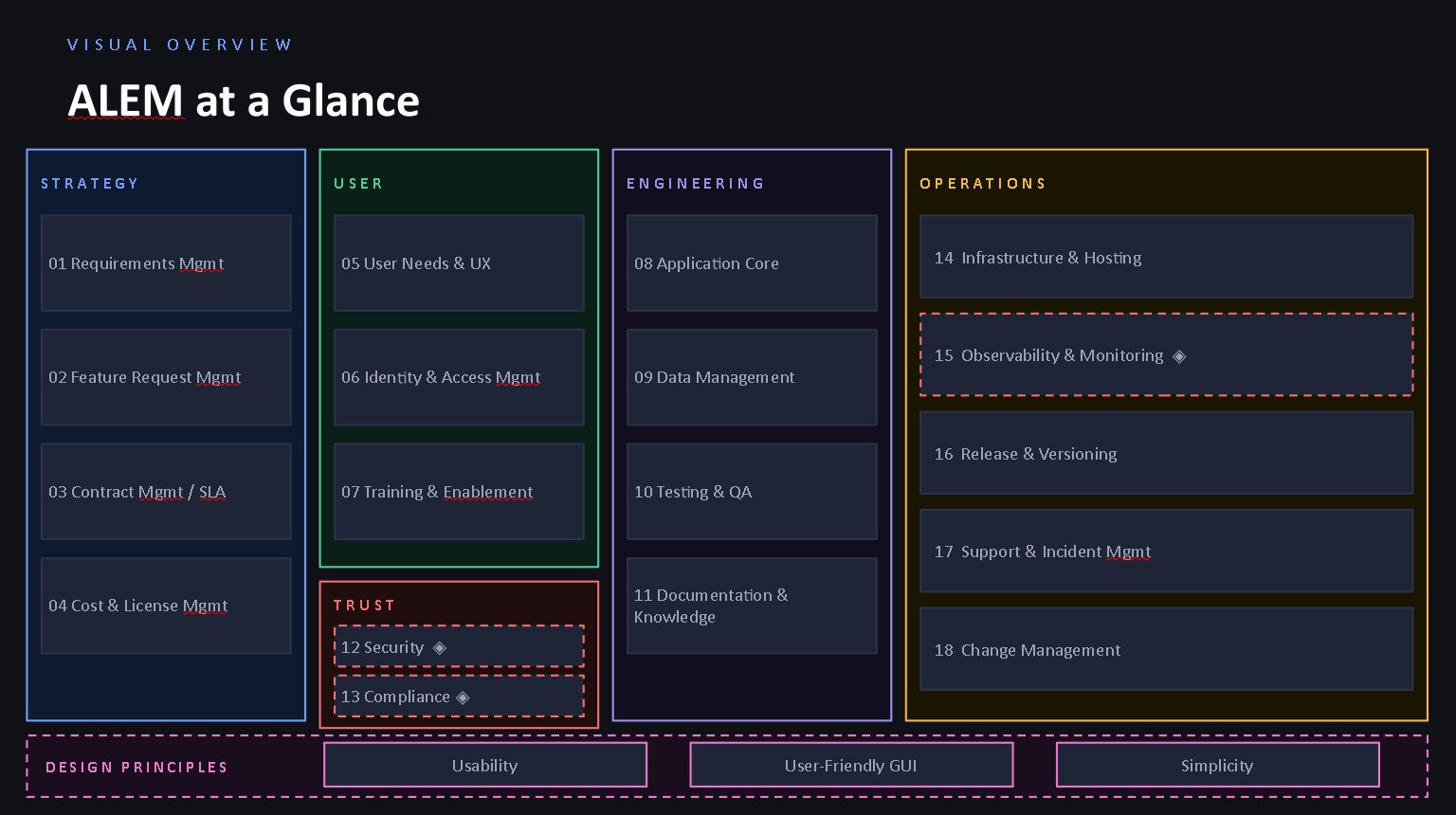
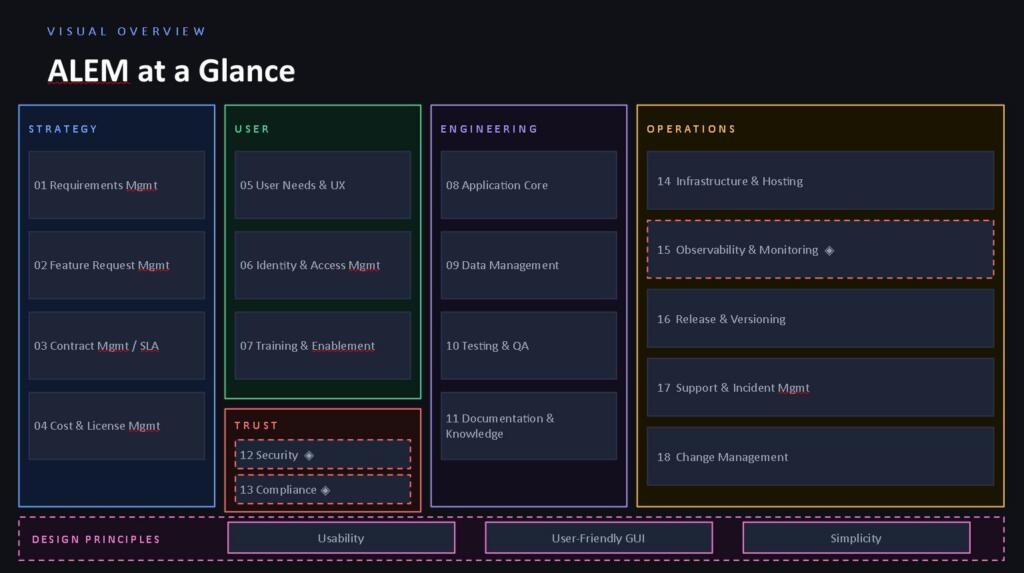
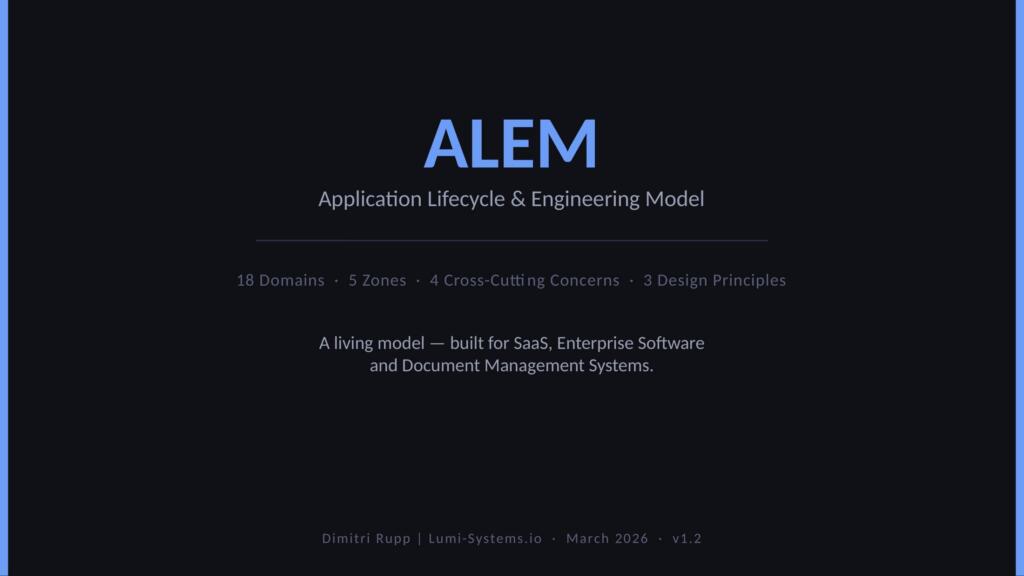
The model structures an application into 18 domains within 5 zones, complemented by 4 overarching cross-cutting topics and 3 Design Principles as a quality benchmark.
The 5 zones – a structured overview
ALEM divides a software application into five clearly delineated zones. Each zone represents a specific area of responsibility – with concrete domains, tools, and standards.
🔵 Zone 1 – Strategy
The Strategy zone answers the question: Where are we developing the application to, and under what framework conditions? It comprises four domains:
- 01 · Requirements Management – systematic capture and prioritization of user needs (user stories, requirements specification, MoSCoW)
- 02 · Feature Request Management – structured handling of customer requests and product further development
- 03 · Contract Management / SLA – definition and monitoring of all contractual obligations (uptime, RTO, RPO)
- 04 · Cost & License Management – full transparency over infrastructure costs, license models, and TCO
🟢 Zone 2 – User
The User zone puts people at the center of all decisions. It comprises three domains:
- 05 · User Needs & UX – user research, GUI design, usability testing, accessibility (WCAG 2.1)
- 06 · Identity & Access Management – authentication (SSO, MFA, OAuth 2.0) and authorization (RBAC, ABAC)
- 07 · User Training & Enablement – active empowerment of all users; the link between GUI and humans
🟣 Zone 3 – Engineering
The Engineering zone describes the technical build of the application. It comprises four domains:
- 08 · Application Core – business logic, APIs (REST, GraphQL), microservices, event bus
- 09 · Data Management – Databases, Migration, Backup & Recovery, Retention Policies
- 10 · Testing & Quality Assurance – Unit Tests, E2E, Performance, User Acceptance Testing, CI/CD
- 11 · Documentation & Knowledge Management – API Docs, Architecture Documentation, Knowledge Base, Onboarding
🔴 Zone 4 – Trust
The Trust Zone is structurally special: It contains exclusively Cross-cutting topics – Domains that do not form an isolated layer but vertically penetrate all other zones. It comprises two domains:
- 12 · Security ◈ – Zero Trust Architecture, Encryption, Penetration Testing, Incident Response
- 13 · Compliance & Governance ◈ – GDPR, NIS2, ISO/IEC 27001, SOC 2, Risk Management
The symbol ◈ marks cross-cutting topics: They are not optional – they affect every zone simultaneously.
🟡 Zone 5 – Operations
The Operations Zone encompasses everything that happens after development: operation, maintenance, and further development. It contains five domains:
- 14 · Infrastructure & Hosting – Cloud, Docker/Kubernetes, IaC (Terraform, Ansible), Disaster Recovery
- 15 · Observability & Monitoring ◈ – Prometheus, Grafana, OpenTelemetry, SLI/SLO/SLA Measurement
- 16 · Release & Versioning – Semantic Versioning, CI/CD Pipelines, Blue/Green Deployments
- 17 · Support & Incident Management – P1–P4 Prioritization, Escalation Paths, Post-Mortem, SLA Tracking
- 18 · Change Management – organizational support for changes, train-the-trainer, migration plans
The 3 ALEM Design Principles
In addition to the 18 domains, ALEM defines three overarching design principles – not a separate zone, but a quality benchmark, which is to be applied to every decision in every domain:
- Usability – Can users achieve their goals efficiently and with satisfaction, regardless of their prior technical experience?
- User-friendly GUI – Is the interface visually clear, consistent, and immediately understandable?
- Simplicity – Is the solution designed as simply as possible? Is complexity reduced – and not merely hidden?
„Perfection is achieved not when there is nothing more to add, but when there is nothing left to take away.“
– Antoine de Saint-Exupéry
ALEM in practice: Document Management System
To show how ALEM is applied in practice, we look at the implementation case of an enterprise document management system in a large organization with multiple departments.
In such a project, not all 18 domains are equally weighted – but all are present. The following domains prove to be particularly critical:
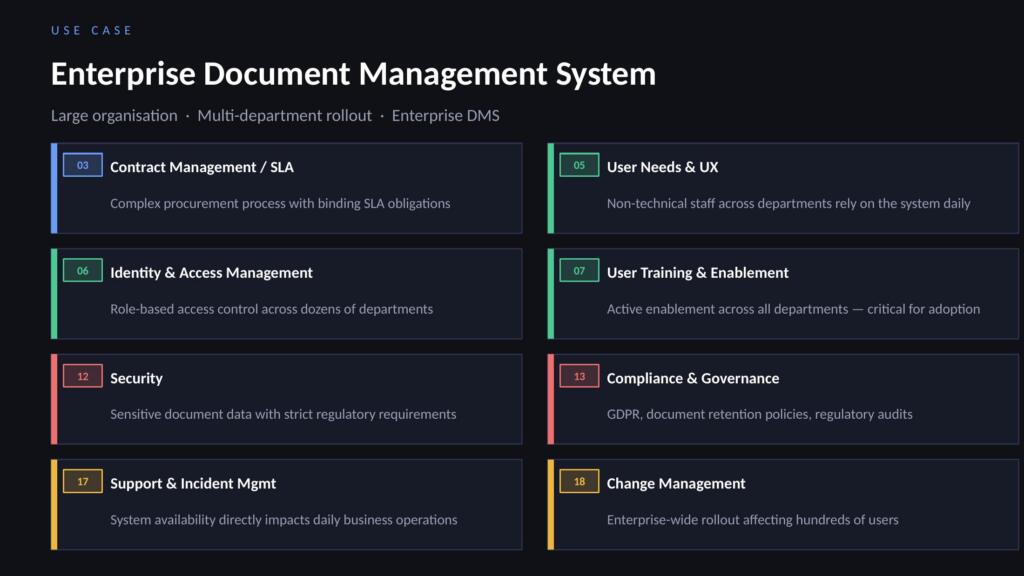
Particularly noteworthy is Domain 07 – User Training & Enablement: Employees without technical affinity use the system daily. No matter how good the software is, it does not deliver its value if users are not actively enabled to use it. Training is not an optional effort – it is an investment in acceptance and thus in the return on investment of the entire project.
Equally indispensable is Domain 18 – Change Management: An organization-wide rollout affecting hundreds of users does not fail because of technology. It fails because of people. ALEM explicitly addresses this as a standalone domain.
The investment question – and the honest answer
Yes – it is true: Anyone who truly wants to fully implement ALEM in software development must invest. In people, in processes, in tools. This is not a matter of opinion, but of reality.
However, the decisive question is not, whether these investments are necessary. The decisive question is whether one includes the costs of not investing truly fully in the calculation.
The return on investment of a fully implemented ALEM far exceeds the investments made. And this return is not only financial in nature. It shows in areas that are difficult to quantify – but that determine a company's success in the long term:
- The standing and reputation of the manufacturing company in the market
- The Identification of customers with the product and the company behind it
- The Respect of competitors in the same market segment
- The Identification of one's own employees with their work and their employer
In over 30 years of IT experience, I have seen only very few companies that truly understood these connections and implemented them consistently. One of them was a company in the USA – founded by a visionary who, unfortunately, died of cancer far too young – and that today has a company value of over one billion dollars. No coincidence.
Conclusion: The choice is yours
You can continue to find low-cost explanations for why the necessary investments and efforts are currently not possible – and continue trying to run in knee-deep swamp.
Or you take the time to understand ALEM, internalize it, think about it seriously – and then decide anew what kind of software manufacturer you want to be.
The model is open. The decision is yours.
About the Author
Dimitri Rupp is the founder of Lumi-Systems.io and IT specialist with over 30 years of experience in the software industry – in positions ranging from technical support to Head of Operations and AI & Cloud Solutions. ALEM is the result of this experience: a field-tested model for everyone who wants not only to develop software but truly understand it.
📎 The complete ALEM documentation as well as the interactive presentation are available on request.
📬 Contact: dimitri.rupp@lumi-systems.io